
Recovery of Corrupted VM Data from Damaged RAID 5 Array
HP Server RAID 5 Data Recovery Case

Client Scenario
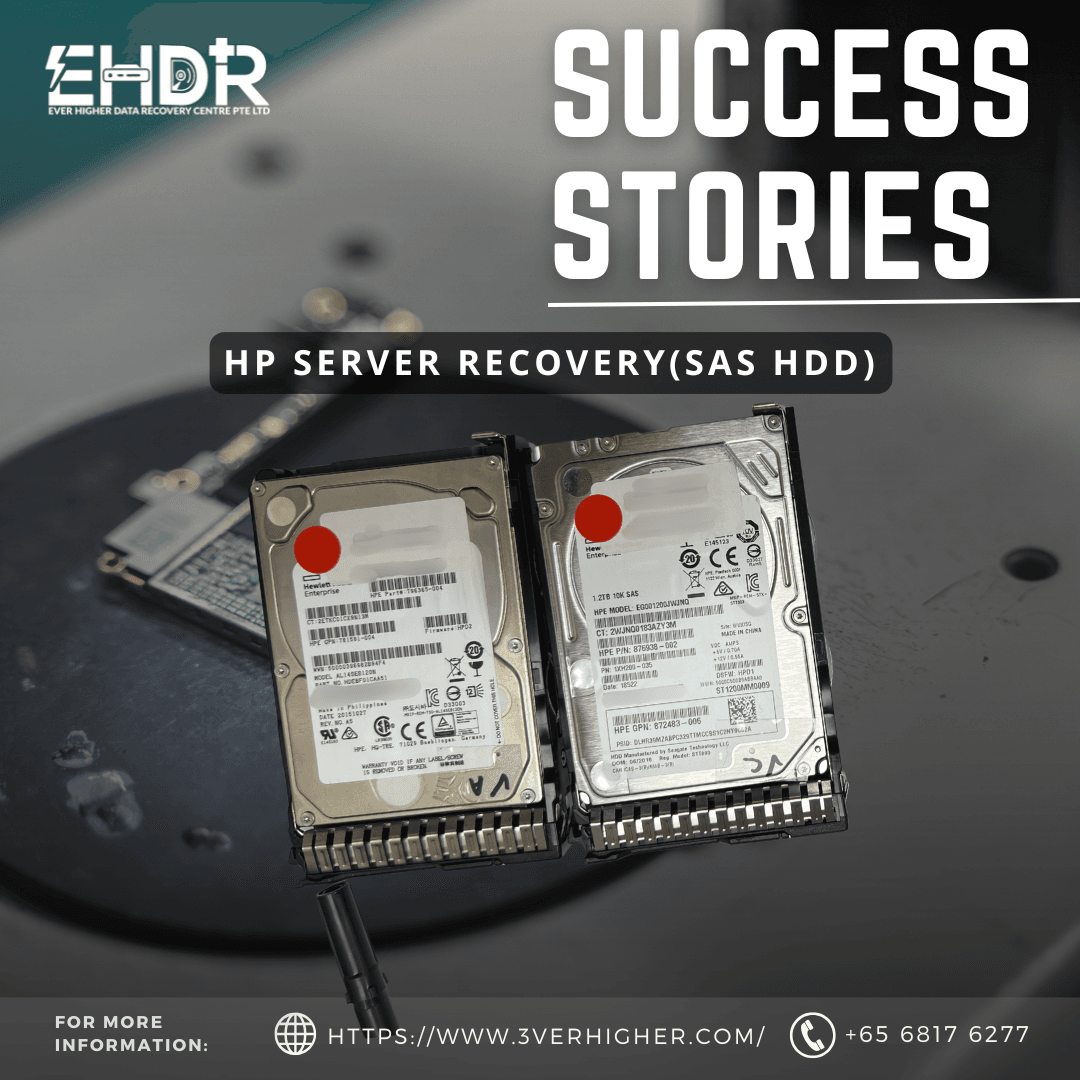
A business-critical HP server experienced RAID failure, impacting multiple virtual machines stored as VHD files. The client required urgent recovery of recent VM data (2025) because the previously recovered files were outdated and unusable.
System Overview
- Platform: HP Enterprise Server
- RAID Configuration: RAID 5 (6 × SAS HDDs)
- Storage Type: Virtual Disk Files (VHD)
- Data Profile: Small number of large files with high integrity dependency
Initial Condition of Drives
The RAID array presented multiple simultaneous failures:
- 1 drive: Not detected
- 2 drives: Weak read heads (unstable)
- 1 drive: Extensive bad sectors
- 1 drive: Partially healthy
- 1 drive: Healthy (baseline reference)
A previous vendor successfully cloned all drives, preserving raw data. However, VM recovery was unsuccessful, indicating deeper logical inconsistencies.
Observed Issues
Initial reconstruction attempts revealed:
- All VHD files appeared corrupted.
- File systems mounted successfully.
- The directory structures looked intact.
- File carving tools (R-Studio, DMDE) produced only partial recovery.
- Recovered data contained files only up to 2024, despite confirmed system usage in 2025
This mismatch indicated a logical inconsistency due to incorrect underlying data. A highly deceptive RAID failure scenario.
Technical Challenge #1: Parity Delay Misalignment
Problem
HP RAID systems may implement a parity-delay mechanism, in which parity blocks are written with an offset relative to the data blocks.
- In this case: Parity Delay = 16 stripes
- Incorrect interpretation leads to stripe misalignment.
Impact
- RAID reconstruction appears correct
- File systems mount normally.
- No missing folders or structural errors
- All large files (VHD) remain corrupted.
Why It Was Deceptive
Because the dataset consisted mainly of large VHD files:
- There were no obvious signs of corruption (e.g., missing files)
- The RAID “looked correct” but produced unusable data.
Recovered RAID Parameters
After validation:
- RAID Type: RAID 5 (Backward)
- Parity Delay: 16
- Chunk Size: 512 sectors
- Disk Order: Verified
Despite correct reconstruction, data corruption persisted, indicating a secondary issue.
Technical Challenge #2: Stale Data in a Degraded RAID
Root Cause
Further analysis revealed:
- One drive likely failed as early as 2024
- The system continued operating in a degraded state (5 active drives)
- The failed drive contained outdated (stale) data.
Why This Matters
RAID 5 tolerates one failed disk, but only if:
- Rebuilds occur properly
- All participating disks represent the same data timeline.
Including a disk with stale data:
- Breaks parity calculations
- Causes stripe inconsistency
- Corrupts large files (especially VHDs)
Recovery Approach
To identify the correct dataset:
- Systematic Disk Exclusion Testing
- Reconstructed RAID multiple times
- Each iteration excluded one disk:
- Rebuild without Disk 1 → Validate VHD integrity.
- Rebuild without Disk 2 → Validate
- Repeat for all drives.
- Data Validation
- Mounted reconstructed volumes
- Verified VHD structure and usability
- Checked for the presence of 2025 data
- Identification of Valid Disk Set
- Determined the correct combination of 5 drives
- Excluded the disk containing stale data
Key Insight
In RAID recovery, a disk can be physically readable but logically invalid. Even a single outdated disk can:
- Corrupt the entire RAID reconstruction or,
- Mislead recovery efforts despite “successful” rebuilds.
Outcome
EHDR specialist successfully identified the correct RAID configuration, eliminated a stale data source, reconstructed the RAID with valid, consistent data, and restored usable VHD files containing 2025 data.
Conclusion
This case highlights two critical RAID recovery challenges. Parity delay can invalidate reconstruction. Standard tools may not detect these automatically. A recovery specialist MUST NOT assume that all disks represent the same point in time. That is why logical validation is as critical as physical recovery.
RAID recovery is not just about rebuilding the structure, it requires:
- Deep understanding of RAID behavior
- Advanced validation techniques
- Extensive trial reconstruction
Without expert intervention, cases like this often result in false-positive recoveries, corrupted critical data and permanent data loss.
More Success Stories>>>>>>

Professional Data Recovery Services
Secure • Confidential
SUCCESS STORIES
Over 14 years of enterprise data recovery experience